

Last Friday evening, the Cruising Division gathered for its regular First Friday Dinner, which was made even more special by a trio of talented guitarists, all club members, who performed throughout the evening. Their music created a relaxed and welcoming atmosphere, adding a wonderful touch to the night. It was a pleasant surprise for many guests, and their performance was so well-received that we would certainly welcome them as a regular feature of our First Friday dinners.
Before dinner, the room was buzzing with conversation and laughter. Members clearly relished the opportunity to reconnect, and the lively pre-dinner catch-ups made it almost difficult to call everyone to their tables. Once seated, guests enjoyed a delicious meal, with our chef offering a variety of entrées, mains, and desserts that were well received by all.
The Highlight of the Evening
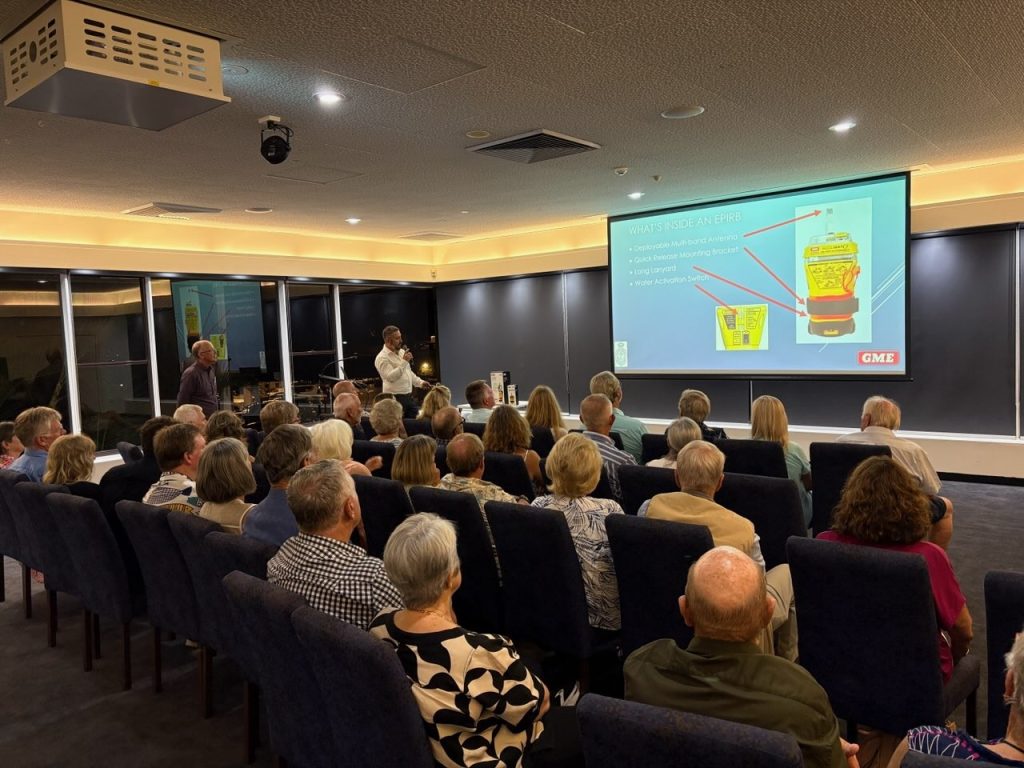
Following dinner, members were treated to a fascinating and informative presentation on EPIRBs and Personal Locator Beacons (PLBs).
The session explored the history of EPIRBs and the work of GME, an Australian-owned family company that designs and manufactures around 30% of the world’s EPIRBs and PLBs from its facility in Winston Hills. GME also produces communications equipment widely used in the four-wheel drive industry.
Our presenters were Gary Robinson, an RPAYC Cruising Division member and consultant to GME, and Zeljko Beljic, GME’s Senior Beacon Designer. Together they provided valuable insights into how these life-saving devices operate.
Gary and Zeljko explained how EPIRBs and PLBs function, demonstrated their features, and showed members how to correctly test their beacons to ensure the battery meets the 48-hour operational requirement. They also covered the GPS functionality that enables accurate positioning during emergencies.
One particularly interesting point discussed was the 50-second window available to deactivate a beacon after accidental activation, helping prevent unnecessary search-and-rescue responses, and avoiding the possibility of a helicopter suddenly appearing overhead, followed by a false call-out notice in the mail.
The presenters also highlighted some new technological developments, including innovative magnetic mounting brackets designed to prevent unintended automatic activation caused by rain or sea spray on devices with automatic triggering systems.
Members were shown how to manually activate an EPIRB, as well as the correct way to dispose of units once they reach the end of their effective lifespan, typically around 10 years, depending on the manufacturer. This timeframe includes allowances for regular self-testing to ensure the beacon remains operational.
An interesting difference between the devices is that PLBs include a confirmation indicator that shows the user when their distress signal has been received. GME is currently working on bringing similar functionality to EPIRBs, along with future developments that may enable two-way communication between rescuers and those in distress.
The presentation was both informative and reassuring, highlighting how continued innovation in EPIRB and PLB technology is helping to make offshore sailing safer for everyone.