

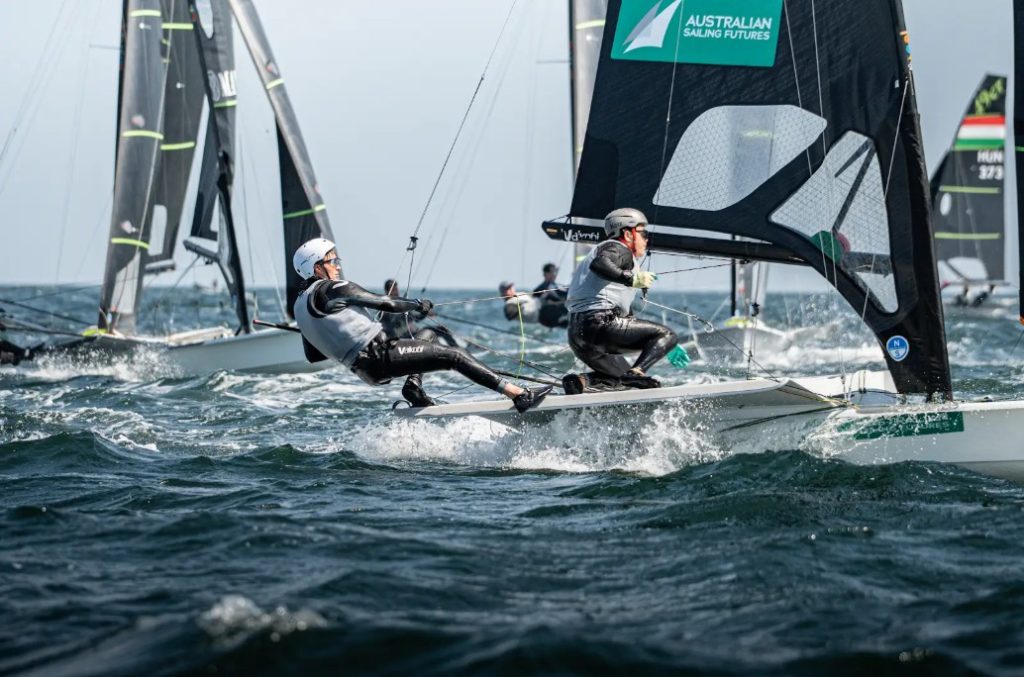
RPAYC sailor Daniel Links recently took on an exciting European campaign, representing Australia at Kiel Week, the 49er European Championships and Junior Worlds. Here, Daniel reflects on his time competing overseas and shares his experiences from the campaign.
In June, Keizo Tomishima and I travelled back to Europe for the second half of our 2026 international season. The trip included Kiel Week and the 49er European Championships in Germany, followed by the Junior World Championships in Medemblik, Netherlands. After the progress we had made earlier in the year at Hyères and the 49er Worlds in Quiberon, our goal was to see if we could take another step and start racing consistently with the front of the international fleet.
Our first event was Kiel Week, which turned out to be by far our best international regatta so far. The 49er fleet had 90 boats and included a very strong group of senior international teams and Olympic campaigners.
The conditions during Kiel were mostly light, around 6–12 knots, which suited us well. We had worked very hard after the Worlds on our starts, speed and communication, and almost immediately we could feel that the work had paid off. We were able to get off the starting line with more confidence, hold our lanes, and actually race the way we wanted rather than always having to find a way out of bad positions.
We started the qualifying series with scores of 8, 2, 4 and 4, which put us in a very strong position and eventually qualified us for the Gold Fleet. From there, we were able to keep racing well against the top boats and won our first international Gold Fleet race. This was a pretty special moment for us and gave us a lot of confidence that our speed and racing had moved forward significantly.
We then qualified for the top 10 final. In the last race of the regatta, we rounded the first top mark in 3rd and eventually finished 2nd, only a few seconds behind the winner. We finished 9th overall out of 90 boats, only four points away from 4th.
Kiel was probably the first regatta where we really felt that when we put everything together,er we could race properly at the front of a world-class senior 49er fleet. It was also rewarding because we didn’t have a coach boat at the event and had to manage our preparation, racing, boat work and debriefing ourselves. At the same time, the result showed us how small the margins are. We still gave away quite a few points through penalties and a couple of tactical mistakes, so although 9th was a result we were extremely happy with, there was also plenty we could improve.
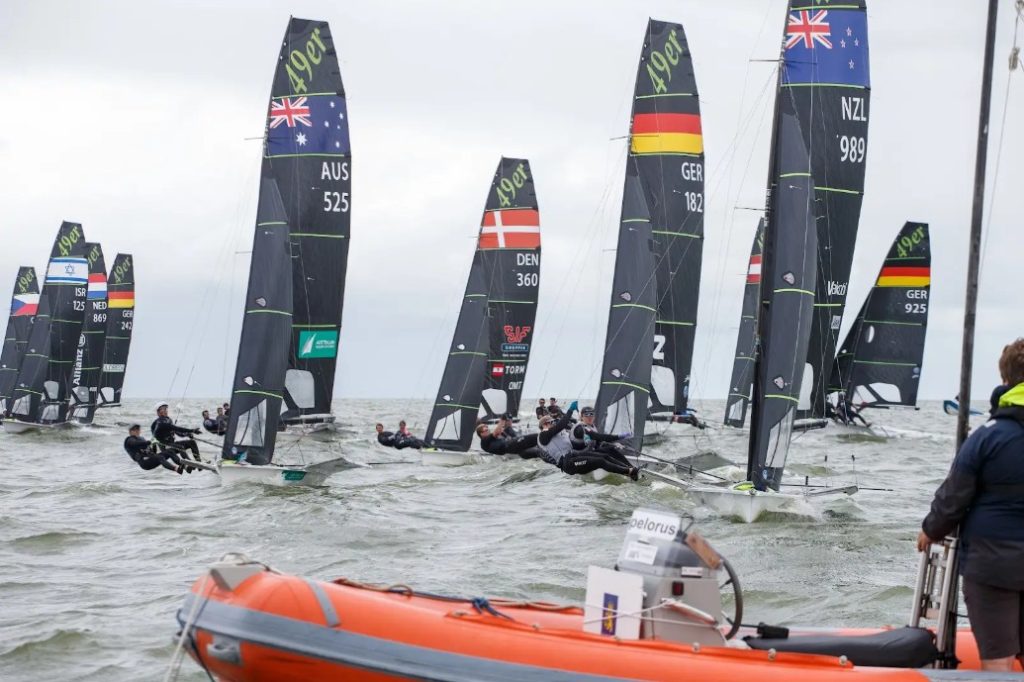
After Kiel, we moved to Eckernförde for the 49er European Championships. The Europeans gave us almost the opposite conditions, with the first few days at 20–25 knots and gusts close to 30 knots, before becoming very light later in the week.
We finished 43rd overall in the 90-boat fleet. The overall result wasn’t what we had hoped for after Kiel, but there were still some really encouraging parts of the regatta. We won one of the qualifying races, had a number of races where we reached the first mark inside or close to the top 10, and finished the final race in 8th.
The biggest difference was that we didn’t convert enough of those good positions into good finishing results. Two OCS starts and two capsizes in the heavy conditions were particularly costly. This was a really useful lesson for us because we came away feeling that speed was no longer the main issue. We were getting ourselves into good positions; the next challenge is becoming much better at protecting those positions for the whole race.
Our final event was the Junior World Championships in Medemblik. This was a 53-boat international youth fleet, and again it gave us a huge range of conditions, from very light racing to 20–25 knots on the final day.
We finished 23rd overall and qualified for Gold Fleet. Some of our better race results were a 4th and a 5th, and in more than half of the races, we were inside the top 10 at the first top mark. Our starting was probably one of the strongest parts of the regatta and it was great to see that the improvements from Kiel continued through the Europeans and Junior Worlds.
Again, the main learning was converting those strong first parts of races. There were several races where we had opportunities for top-10 results but lost places due to strategy, a UFD, or mistakes later in the race. In the final race, we were actually racing in 4th in very strong conditions before capsizing on the final run. These mistakes can be frustrating, but they have also made it very clear what we need to work on next.
Looking back over the whole European season, Keizo and I are extremely happy with the progress we have made. At the start of the year, we were still trying to prove to ourselves that we had the speed to race with the top international boats. Kiel was a massive confidence boost because it showed that when we put together our speed, starts, communication and decision-making, we can race at that level. The Europeans and Junior Worlds then showed us where the next gains need to come from.
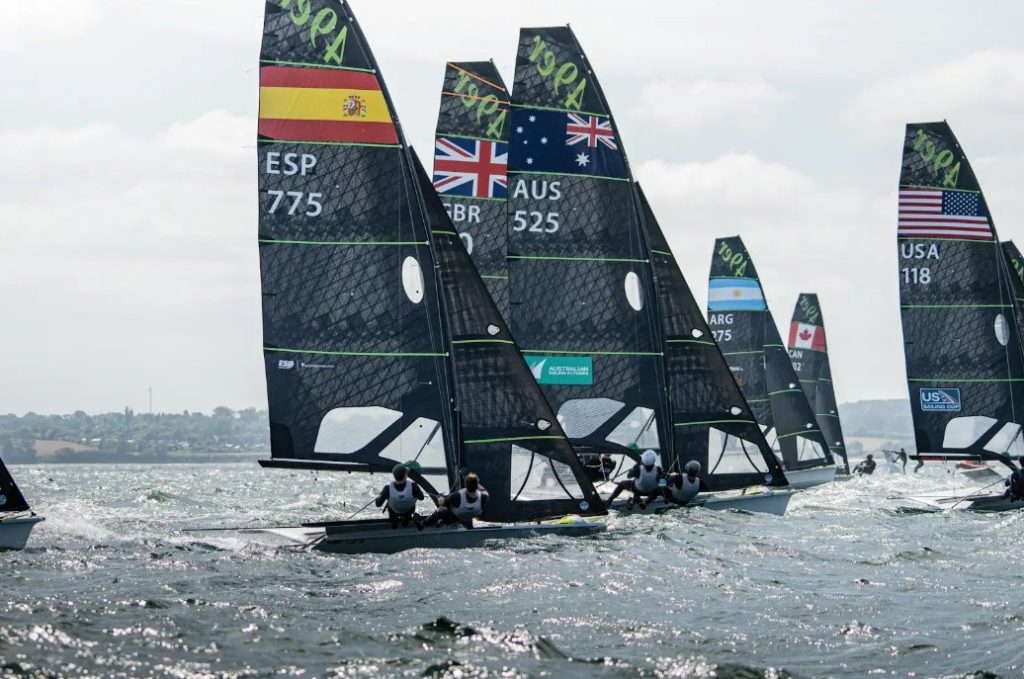
We are now back in Australia and have a big training period ahead of us. Our focus will be on improving our heavy-air sailing, strength and fitness, boat handling and converting good starts and first beats into complete races. We also want to do as much high-quality fleet racing as possible over the Australian summer.
Our planned 2027 international season is another big step. We are looking at racing in New Zealand early in the year before returning to Europe for Palma and French Olympic Week in Hyères. We then plan to return to Kiel in June before the major target of the season, the World Championships in Gdynia, Poland. If selected, there is also the opportunity to compete at the Olympic Test Event in Los Angeles later in the year.
Our longer-term goal remains working towards the Los Angeles 2028 Olympics, but there are many steps between now and then, and our focus is on continuing to improve each training block and regatta.
We are extremely grateful for the ongoing support from the Royal Prince Alfred Yacht Club and everyone who has helped us throughout the campaign. International 49er campaigning involves a huge amount of travel, equipment, coaching and logistics, and that support makes a genuine difference to what we are able to do.
As we start putting together the programme for 2027, we are also looking to grow the group of people and partners supporting the campaign. If any RPAYC members are interested in following our journey more closely or becoming involved, Keizo and I would be very happy to have a chat.
Thank you again to RPAYC for the support, and we look forward to keeping everyone updated throughout the Australian summer and into the 2027 season.